
Growing your Email Marketing List
Your house-list of opted-in email addresses can be a major digital marketing asset. This section shares best-practices for growing your list.
Email is a productivity tool for most people, and so it is important for marketers to get permission before mailing people. For this reason it is important that marketers work on getting more people on their opt-in email list.
Setting up List Magnets
Content that is highly attractive can be used to entice people to sign up for your email marketing list. We call this type of content a "list magnet" - in other words it attracts people to sign up to your email list.
Almost every interaction with customers can be used to gain their permission for you to send them emails. Many emails marketers have found it beneficial to incentivise email sign-ups by offering something valuable, and askinh if they would sign up to your newsletter at the same time.
Examples of valuable content include articles, videos, multimedia, presentations, white papers, gift voucher, music tracks, free attendance to an event, entry into a competition, or simply the offer of exclusive or useful content in a newsletter.
People want to receive content that is relevant to them, and preferably from a trusted brand.

Demystifying the Inbox, 2013. Everlytic & Effective Measure
62% of people subscribe to email newsletters for news and expert information
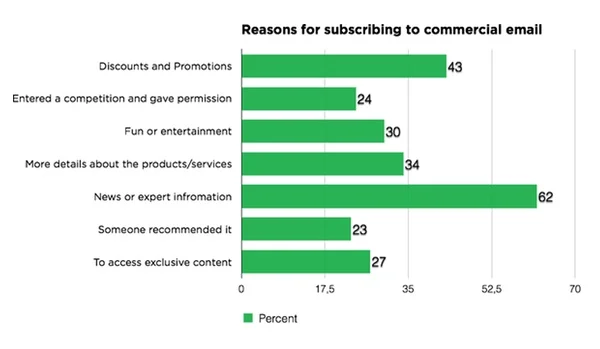
Demystifying the Inbox, 2013. Everlytic & Effective Measure
Create a compelling email signup page
Once you've decided on what your incentive for signup is going to be (your list-magnet), you should make it as easy and compelling as possible for people to give you their details and permission for your contact.
Here is an example of a good email landing page (for Treeshake's Social Content Canvas)

- Display your trusted brand prominently
- Remind people why they’re here
- Sell the benefit
- Give more information
- Make it real with a preview- show them what they’re getting
- Call to action
- Email opt-in
- Button-text links to the action
- Encourage people to share the goodness
BEST PRACTICES FOR SIGN UP FORMS
Above the fold and on every page.
Conventionally in the sidebar of your site
Research shows that sign up forms on ABOUT PAGES are highly effective.
Privacy and anti-spam policy for subscribers. Let them know what will their info be used for AND how THEY will benefit
Make the call to action clear, and put it on a nice big button so they can't miss it.
Test to see that it your email sign-up page is working by testing and optimising it.

Email Service Providers we like
An email service provider (ESP) is a company that offers bulk email software and services. There are an overwhelming number of these companies around, so we have selected a few credible providers for you to have a look at and choose your favourite.
An email service provider (ESP) is a company that offers bulk email software and services.
An ESP may provide tracking information showing the status of email sent to each member of an address list. ESPs also often provide the ability to segment an address list into interest groups or categories, allowing the user to send targeted information to people who they believe will value the correspondence.
General Email Service Providers
MailChimp: allows you to do incredible things with email, like integrating your email lists' social media data to help you target and personalise.
Campaign Monitor: rated best for beautiful email design templates.
GetResponse: easier to get going with quickly because it has less features, it's also a little cheaper per email than Campaign Monitor and MailChimp.
Emma: Emma distinguishes itself through service. It's team of experts are there to help you do email marketing like a pro, especially on the list management side.
MadMimi: has a fun and easy user experience, and less features than the larger and more complex ESPs.
Constant Contact: good option for small businesses and small non-profits, focusses on non-technical users by providing the simplest features for design and sharing.
GraphicMail: a South African ESP with world-class features and support for companies of any size.
Everlytic: a South African email service provider with world-class features and support, recommended for SA companies with large email lists/
ExactTarget: owned by Salesforce, specialises in customer-journeys and automated realtime email marketing. A good option for large companies with skilled digital marketing teams.
SilverPop: owned by IBM, it offers the deepest analytics and intelligent targeting and automation options. It's recommended for big clients with complex email marketing needs.
TotalSend: full-service South African ESP that is specialising in transactional emails
Vero: focusses on email automation, and behavioural targeting and remarketing particularly.
ESPs may have similar basic features and functionality, but vary in volumes, policies, and deliverability, which makes the selection of an appropriate ESP critical to both the success of an email marketing campaign and the cost effectiveness of its implementation.
ESPs policies, also known as terms and conditions (such as an Acceptable Use Policy), are meant to prevent abuse by users in order to ensure that no spam is sent through their systems. This is intended to result in the best possible delivery rates, with no messages blocked as spam.
An ESP will provide a service which may include the following features:
- Ability to create templates for sending to contacts and/or the use of templates pre-made
- A subscriber list, which is uploaded by the user for distributing messages. This may be enhanced with custom fields in order to hold additional information for each subscriber for filtering and targeted messaging purposes
- A send engine, which allows users to distribute their message to the subscribers
- Updating of the subscriber list to suppress those requesting to be unsubscribed
- Statistical reviews of each email sent to measure the success rate of the campaigns
- Testing of templates for compatibility with email applications
- Spam testing to gauge the score of the email against known factors that will place the template at risk of being blocked
- The ability to send both html and plain text formats to improve delivery success rates (known as Multi-Part MIME)
- The ability to customise dynamically the content of emails that are sent out, to tailor personalised and relevant communications
- The level of service provided can be according to the above basic features, or the number of subscribers uploaded, or the frequency of use – or any combination of the above criteria.
Some ESPs cooperate with Mailbox Providers, through organizations such as the Messaging Anti-Abuse Working Group, to ensure compliance with legislation and best practices, and get feedback on the messages they send.
Do you have a favourite ESP you'd recommend for any particular reason? Please let us know in the comments.
Specialist ESPs
RocketSeed: lets you centrally manage the email signatures for your whole company, and even serve targeted email signatures to different audiences based on who your staff mail.
Litmus: Litmus provide email testing solutions. You can check how your email appears in different desktop and mobile clients, and do advanced testing on the performance of your emails.
Mandrill: has servers around the world to ensure faster delivery of your email. For this reason it is the ESP of choice for automated emails that need to be delivered quickly, like receipts.

Email Marketing in South Africa
Email is the most popular way to share content online, and is the first daily contact point with the internet for most South Africans. This post looks at how email is used in South Africa, and who the main email industry players are.
Email marketing is perhaps the most underrated form online marketing in South Africa. It is highly effective, simple to use, and used by virtually everyone who is online in the country. To give you a bit of context, we've gathered some key research about how people use email in South Africa.
A 2013 research report by Everlytic and Effective Measure entitled "Demystifying the Inbox" found that:
- Over 7 million South Africans start their day online by accessing email
- 4.8 million South Africans have more than one email address
- 53% read email on the mobile phones
The figures in the report are based on a survey of almost 2000 random South African web users.
Email is Social
The Demystifying the Inbox study found that 93% of SA web users share content on email, while only 56% use Twitter and 17% use Twitter.
While the Facebook and Twitter figures are on the rise, email is still a very significant social content sharing channel.
Inbox Volumes

The Demystifying the Inbox study found that average South Africa gets between 120 - 200 emails per week. An interesting insight from the study is that the number of emails you get correlates with how much you earn. Higher income jobs are generally occupied by graduates and professionals who do much of their work on computers. So if you want to reach these people with email marketing, your messaging needs to compete for attention by being succinct and compelling. This is why we pay so much attention to email optimisation such as subject-line and call-to-action testing.
The average South African subscribes to 4-6 email newsletters
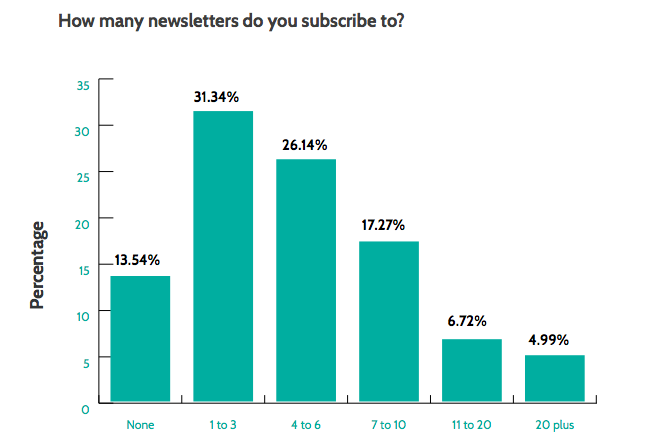
People with higher income tend to subscribe to more newsletters. On average people earning above R30k per month subscribe to between 5 and 7 newsletters. Almost 38% of people earning more than R70k per month subscribe to more than 7 newsletters.
Furthermore, the study found that 73% of South African email users have interacted with an email advert, and 54% of email users have purchased something they saw on email. This number will continue rising along with e-commerce use in the country, which is currently growing at 30% annually. An interesting insight is that women are more likely than men to click on email adverting.
Email Regulation in South Africa
The industry body for email marketing companies in South Africa is the Direct Marketing Association of South Africa (DMASA), who also manage the National Opt-Out list of people who don't want to get any email or SMS communications from DMASA members.
If you're collecting a list you need to ensure you're compliant with the Protection of Personal Information Act (POPI), which is all about protecting your consumer's private information from data theft or loss.

World Economic forum announces Dave Duarte a Young Global Leader

Cape Town: Tuesday, 11 March 2014: The World Economic Forum (WEF) today announced South African Dave Duarte as a Young Global Leader (YGL). Globally recognised as a top expert on digital marketing for business, Duarte joins 215 leaders from around the world that will make up the class of 2014, including South African actress Charlize Theron.
Annually, thousands of candidates go through a qualified nomination process and are assessed according to rigorous selection criteria. Only the best are selected to form a community of the world’s next generation leaders.
“Young Global Leaders are not just exceptional people in their own right: they are leaders that already have a track record in improving the state of the world. We welcome the Class of 2014 into our community and look forward to collectively engaging them to deliver change of genuine global significance,” says David Aikman, Managing Director and Head of the New Champions at the World Economic Forum.
As an entrepreneur and educator, Duarte has travelled the world providing insights and strategic advice, his passion being digital leadership. This opportunity is a testament to his work in the field, “I am honoured to have the opportunity join this diverse and dedicated group of leaders and committed to affect real global change. I am also thrilled to be working with fellow South African and social entrepreneur, Marlon Parker, founder of Reconstructed Living Labs who will form part of the class of 2014,” says Duarte.
Duarte has a long list of achievements including pioneering the first Social Media and Mobile Marketing courses in Africa with the University of Cape Town’s Graduate School of Business. Currently he focuses on his latest venture, Treeshake, an educational production company that invests in initiatives that could grow Digital Leadership in Africa.
He has spent the past few years working with executive teams in Africa and globally to influence this new form of leadership since the advent of digital has changed the pace of business.
“Digital Leadership is, I believe, the most critical new form of management and business development that is needed on the continent. It is about being able to innovate in response to challenges and opportunities using digital technologies that are incredibly quick to build, launch and scale. Ultimately, it is about aligning leadership to the speed, scale and sophistication of business today,” adds Duarte.
Besides his responsibilities as a YGL, Dave also helps identify the top African technologies to be awarded at the Netexplo forum at UNESCO in Paris later this month.
Duarte now joins an elite group of young leaders that in the past have recognised people like Larry Page, Co-Founder and Chief Executive Officer of Google, Michael Jordaan, former chief executive officer at FNB and Mark Shuttleworth, internet entrepreneur and Afronaut .

The Importance of Digital Leadership
Online social networks operate in similar ways to our real-world ones, in that they are held together by trust and influence that isn’t evenly distributed. The web has given a platform to leaders to get into direct contact with their followers and stakeholder communities. As an example, consider Helen Zille’s statement regarding her recent spat with a senior journalist that “today I can reach, in a single tweet, more than double the weekly circulation of her newspaper”.
However, the transition hasn’t been smooth for leaders who have struggled to grasp the medium - whether because of their own gaffes or because of their struggle for relevance. Similarly, the web has given a new kind of leadership the opportunity to emerge. Consider Khaya Dlanga’s reach and influence as a result of his hugely engaging online personality and opinion pieces.
Digital Leadership is the emerging field that looks at how groups come together online and how they are influenced to act. It looks at the culture of online communities and how information and ideas spread from person to person. It is about refining your ability to think, decide, act and communicate more quickly in response to today's real-time market pace.
Our communications are increasingly handled digitally - be it mobile phone calls and texts, or emails and instant messages. Digital Leadership considers also the kinds of interactions that different digital channels encourage, be it blogging and podcasting, Facebook, Twitter, LinkedIn, WhatsApp, or even secure corporate intranets and email.
Digital Leaders should consider how digital technologies impact on what they’d consider their “real world culture”, as the boundaries are increasingly blurred. And culture is what enables the performance of many of the best companies, teams and countries.
Digital Leadership is, I believe, the most important new form of management and business development that is needed on the continent. It is the ability to work with remote teams using modern technologies to get things done. It is about being able to innovate in response to challenges and opportunities using digital technologies that are incredibly quick to build, launch and scale. Ultimately, it is about aligning leadership to the speed, scale and sophistication of business today.