SHOW DON’T TELL
The first rule of politics, said South African politician Helen Suzman, is "Go see for yourself."
On 24 June 1995, Nelson Mandela walked onto the grass at Ellis Park in a green and gold Springbok jersey with the number six on the back. François Pienaar's number. For most of the 62,000 people in that stadium, the jersey had been, for most of their lives, the uniform of the other side. Apartheid's team. White South Africa's team.
Mandela didn't make a speech that afternoon. He didn't issue a statement or release a position paper on reconciliation. He put on the jersey, raised his cap, and walked out into a stadium that started chanting his name.
All Blacks captain Sean Fitzpatrick later said he didn't think anyone else could have done what Mandela did in terms of uniting a nation. Ian Jones told the Springboks afterwards: "You had 16 on the field. You had Nelson Mandela." A 12-year-old Bryan Habana, watching at home, said the image ignited a dream in a boy who had never played rugby before.
One man. One jersey. One walk across a field. A new country, in a single frame.
Screenwriters and novelists use Show Don’t Tell to pull our hearts and minds into their world. It’s the most reliable engine of narrative change we know, and it has been ever since leaders had to be seen by the people they led. What will memorably land this, in a way words can’t?
Our brains weren't built for Big Numbers
Anyone can say a politician is corrupt. Anyone can say a programme is working. Saying is cheap, and saying is contestable. The side with the simplest, most emotive story tends to win.
This is not a South African problem. It is a human one, wired into the architecture of how our minds are made.
Nicholas Kristof spent 2004 in Darfur trying to make the world care about a genocide. He had the numbers, the eyewitnesses, a column in The New York Times. And he watched a red-tailed hawk evicted from a Central Park nest generate more public energy than a hundred thousand dead Sudanese. His diagnosis was honest: "We are hardwired to feel a certain amount of empathy and connection, but with one other person whom we see and we can relate to. Not with 100,000 people half a world away." (Big Think)
The reason is not callousness. It is cognitive architecture. The psychologist Paul Slovic calls it psychic numbing: our emotional response to suffering does not scale with the numbers. It actually flattens. One death is a tragedy. A thousand is a statistic. A million is beyond feeling altogether. His related concept, the Identifiable Victim Effect, replicated again as recently as 2024, shows that a named, specific person in a story we can enter generates more action, more donation, more political will than any number of unnamed thousands. Every time.
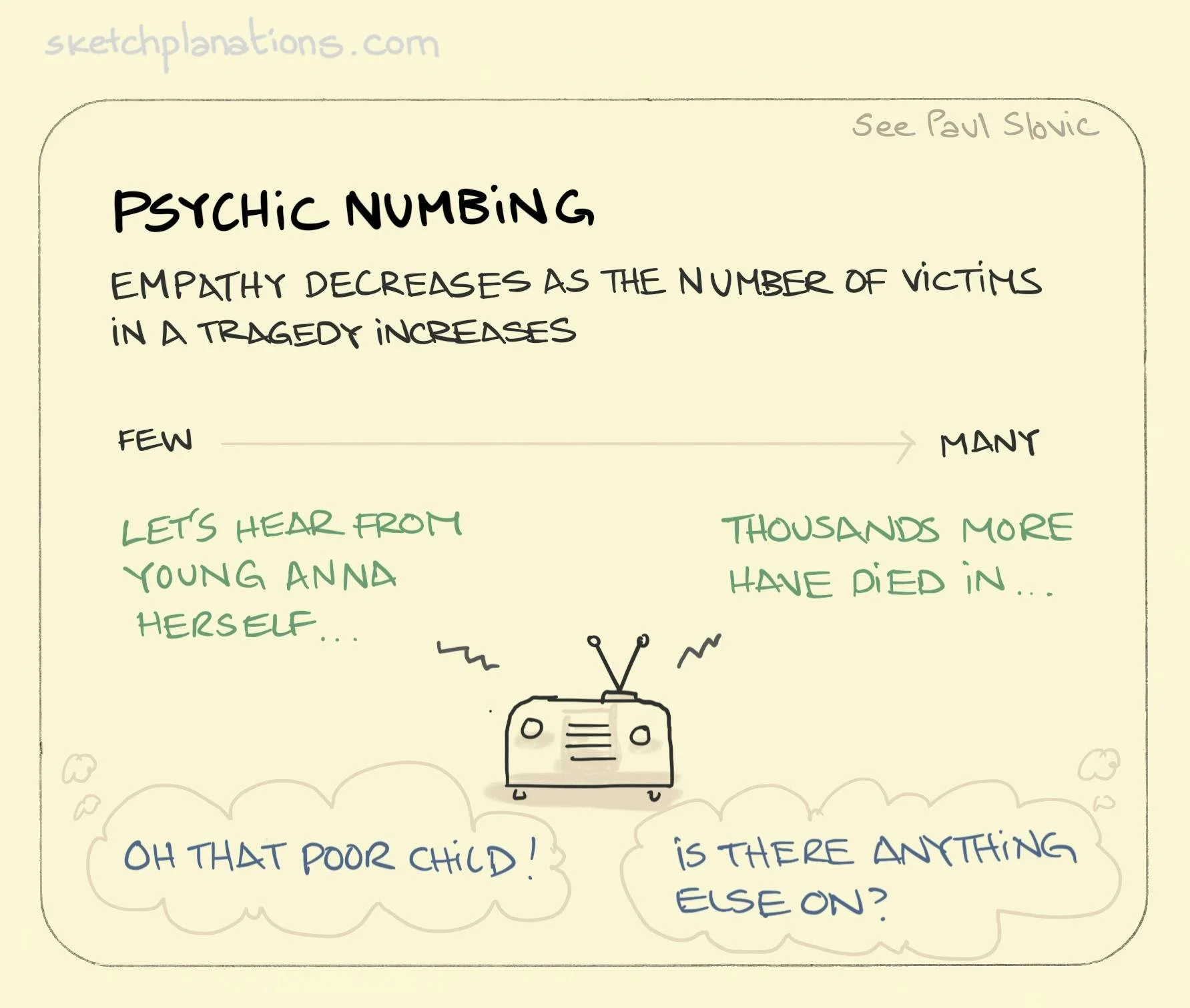
Image: Jono Hey, Sketchplanations
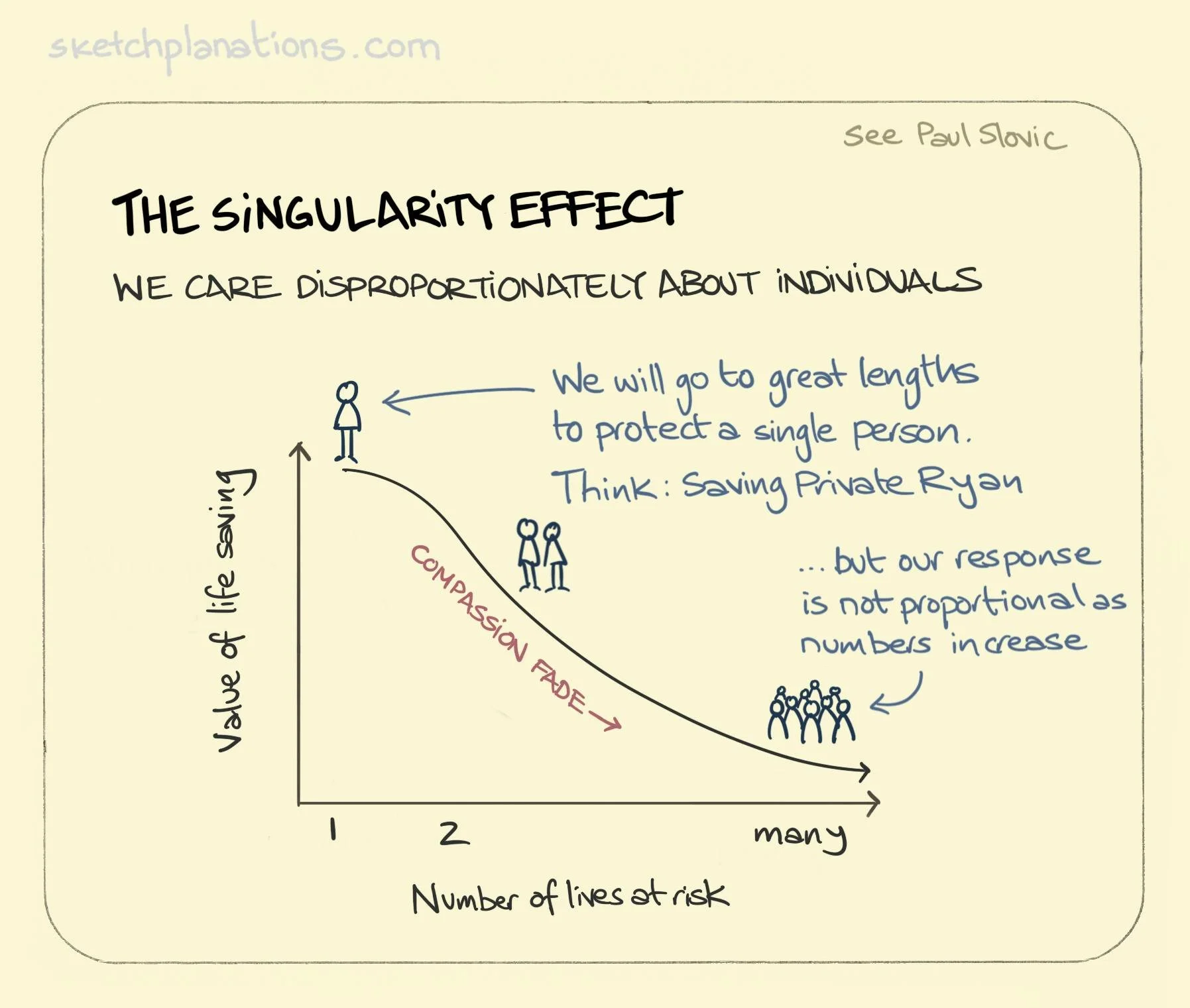
Image: Jono Hey, Sketchplanations
This is why Alan Kurdi, the three-year-old Syrian boy photographed face-down on a Turkish beach in 2015, moved more refugee policy in two weeks than years of reports had. Why Hind Rajab, the six-year-old girl in Gaza whose last phone call to emergency services was broadcast around the world, became a name people carried in their bodies. Why a single euthanised squirrel trends while statistics about species collapse do not.
We are not built to grasp “hyperobjects”, whether those are genocides or collapsing municipalities or the gap between a million and a billion.
The numbers blur. The face does not.
When one person steps into that blur and says: I understand this, I can see what it is doing to you, and I am going to do something about it, that is when people follow.
Not because the argument was won. Because the scale became human.
This is why framing a problem in numbers is statistically less likely to land than putting a person inside a story that matters.
Stories now move faster than facts, and faster than law
In August 2025, two executives from a state-owned entity arrived at a Stellenbosch restaurant carrying a white Dior shopping bag stuffed with R200 notes. They placed R60,000 on the table and asked investigative journalist Pieter-Louis Myburgh of The Daily Maverick to drop his investigation into a property deal. Myburgh had been filming the whole time. The video went everywhere.
South Africans had been told for years that State Capture is real, that institutions are being hollowed out. They had read the reports, watched the inquiries. Most of it stayed abstract. Then a man pulled a Dior bag out in a restaurant, and you could count the elastic bands.
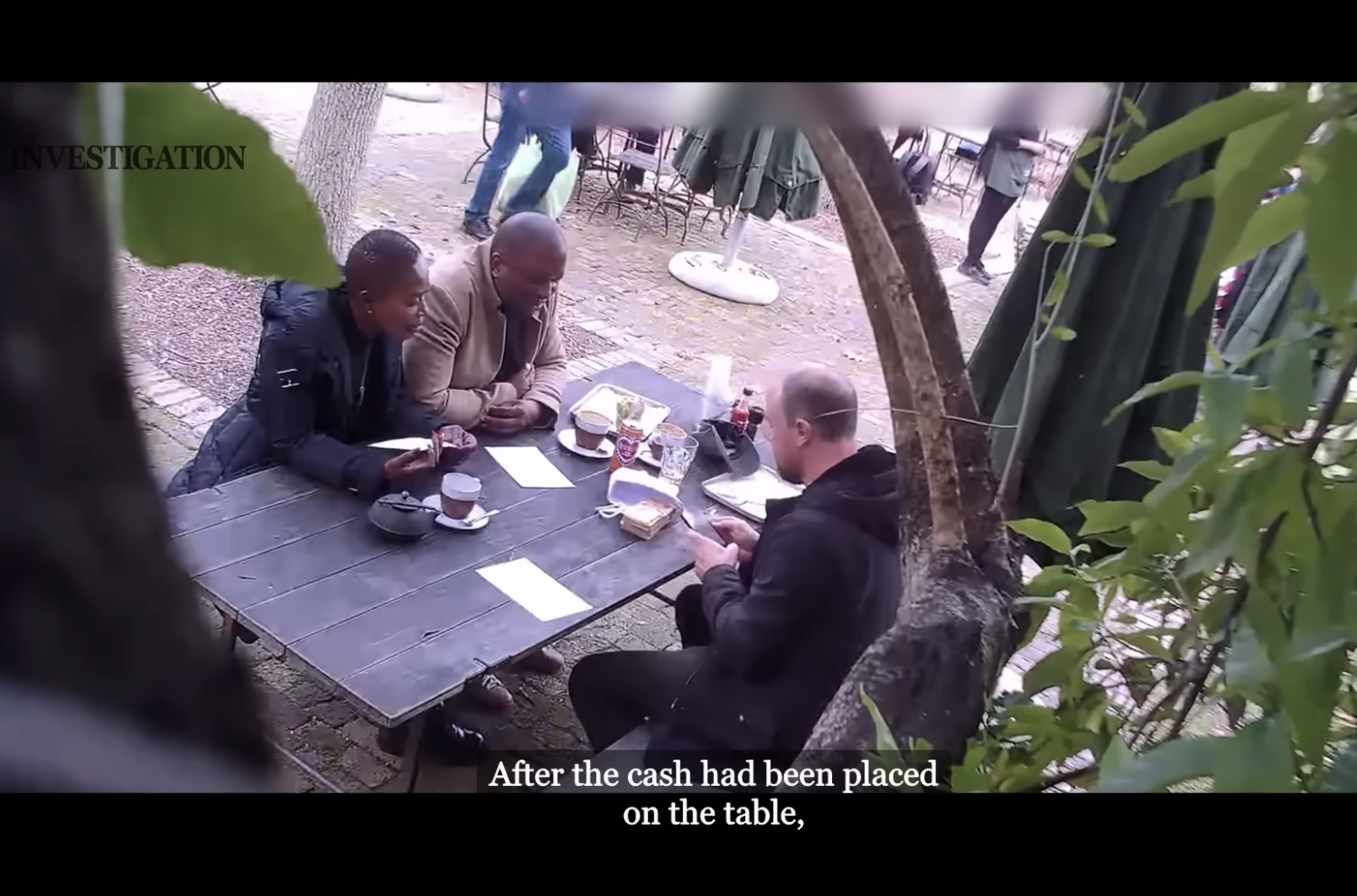
Source: Footage captured via an exclusive investigation by investigative journalist Pieter-Louis Myburgh for Daily Maverick. Watch the full recorded meeting above.
A viewer watching that bag emerge is not being argued with. They are inside the scene, doing the interpretive work themselves.
The underlying mechanism is Narrative Transportation: the more an audience is pulled inside a story, the more their beliefs shift, and the harder counter-arguments become to land.
But the stakes of this go further than political communication. We are now in an era where a strong enough narrative can outrun economic fundamentals and legal guardrails alike. Market logic does not constrain a man whose personal story has become larger than the institutions around him. Courts struggle to hold where a leader commands a narrative that millions have already entered and made their own.
Robert Shiller documented this in Narrative Economics: recessions deepen not only because of structural failures, but because of which stories go viral. Currencies wobble. Investments flee or flood on the strength of a frame. Stories, real or fabricated, can now reshape reality faster than the systems designed to check them can respond.
This is the environment. If you are not actively showing the story you want people to inhabit, someone else will fill the vacuum to show them a different one.
The side that anchors the story wins. The side that explains catches up.
You don’t need to be the Hero
In films, the hero is the one in the middle of the drama. You don’t want to be the one in trouble. Donald Miller's StoryBrand framework is built on one switch that most brands and most politicians get backwards: the hero of your story is not you. The hero is the citizen. Or your crew showing up for them.
"The Hero of your brand story is not you. The Hero is your Customer. They need a Guide to help them fulfil their destiny. You are the Guide."
Translate that out of marketing and into politics: the citizen is the hero. The leader is the guide. Miller's seven beats — Character / Problem / Guide / Plan / Call to Action / Failure / Success — are exactly the architecture of an effective political message.
The fisher who has lost her permit is the character. The dry tap, the blocked drain, the choked harbour is the problem. The mayor is the guide who shows up in their world, listens, asks, and offers a plan. Knows which teams to deploy.
Two things happen when you make that switch. When the spotlight isn’t on you, you stop being a target of frustration, because a leader who actually understands, is on their side. And when you can pinpoint what needs fixing and can demystify the way, you open the path to participation, a shared story to take on together.
What it looks like when it works
Helen Zille is the journalist who, working for the Rand Daily Mail in 1977, exposed the cover-up of Steve Biko's death in police custody. She went on to win World Mayor 2008, led the DA to its biggest growth as a national party, and served as Premier of the Western Cape. By any honest measure: an exceptional career.
Then, in March 2017, she sent a clumsy tweet suggesting the colonial legacy was "not only negative" citing the judiciary and piped water. She apologised unreservedly, was suspended, and ten years later that single tweet remains the line her opponents reach for. When she announced her candidacy for Mayor of Johannesburg, the same loop started again. Colonialism. Racism. On repeat. No quantum of policy detail moved the dial.
So she changed the picture entirely. She didn't argue back. She got in the water.

Source: Campaign footage shared natively via Helen Zille's Official Facebook Feed highlighting municipal infrastructure challenges in Johannesburg
When residents on Balder Road in Douglasdale had been reporting a burst pipe and a pothole-turned-pool for three and a half years, the 75-year-old put on a wetsuit, a pink-and-white swimming cap, and a snorkel, and doggie-paddled through the muddy water, asking if there were any fish in there. She posted the video. Within 48 hours, city officials had dispatched repair crews. Bloomberg called it "a new style of electioneering." The image ran onAP,People, andeNCA.
And it didn't stop there. She rowed an inflatable raft down a flooded street in Dobsonville. She stood with residents during the Melville water crisis and went to the reservoir to question the contractors. She walked Queens Road bridge in Fordsburg with Daily Maverick's Ferial Haffajee and listened. By October, she had done 52 interviews in 10 days, reaching over 40 million people, and the DA was leading internal Joburg polls at 37% to the ANC's 31%.
She didn't win the tweet argument. She refused to keep fighting it. She picked a more powerful frame, one rooted in how media and human memory actually work, and walked her audience inside it. The campaign’s five-pledge platform (water, roads, jobs, safety, professional government) now land inside a story residents have already been transported into.
It takes guts. Sleeves rolled up at St. Helena Bay
A week after he was elected DA federal leader in April 2026, Geordin Hill-Lewis went to the harbour at St. Helena Bay alongside Minister Willie Aucamp to mark the restoration of nearly 300 small-scale fishing vessel permits. He didn't make a speech and leave. He went into the processing facility, rolled up his sleeves, and cut and gutted fish alongside the local fishers. Visbraai with a local chef. Open dialogue with the community who longed to be heard. At eye level while they worked together.
His line on the day is a textbook citizen-as-hero move: "For years the local fishing communities have been disrespected, and now we are putting that right."
The same week, his first walkabouts as federal leader took him into Soweto and Atteridgeville. When Cape Town faced controversy over a proposed N2 wall near informal settlements, he didn't issue a press release. He went and interviewed the affected residents on camera.
The principle running through all of it is one simple switch: you are not the hero, the citizen is, and you are the guide. He keeps showing up. He keeps listening. He keeps making the resident, the fisher, the worker the protagonist of the frame. It is why, less than a month into his federal leadership, he is already among the most talked-about politicians in the country.
Same playbook; different politics
Gayton McKenzie, knows how to run this playbook with a different kind of politics.
In May 2026, South African shot-putter Aiden Smith posted a video from the African Athletics Championships in Accra. The accommodation was a wreck: no blankets, no hot water, one chicken bone per athlete. McKenzie, as Sports Minister, saw the video, immediately directed his department to arrange alternative hotel accommodation for Team SA, and ordered a full investigation into Athletics South Africa. A few days later he publicly congratulated Smith on winning gold.
One athlete. One phone video. A swift intervention championed through a single face.
The method is ideology-neutral, which is precisely why leaders whose work builds rather than divides, need to recognise this tool, and use it for leverage.
Pass the Mic to the people already doing the work
There is a dimension to this that often gets missed: showing up is not only for where things have gone wrong.
Every city has people doing the unglamorous, invisible work of keeping things functioning. The clerk processing permits at 4pm on a Friday. The crew showing up at 2am to fix a burst main before school opens. The housing officer who has been quietly navigating the same family through a backlog for eighteen months.
These people rarely get named. Their work rarely enters the political story. And because it doesn't, it becomes harder to recruit the next generation into it, harder to build the institutional pride that makes public service a thing people aspire to rather than endure.
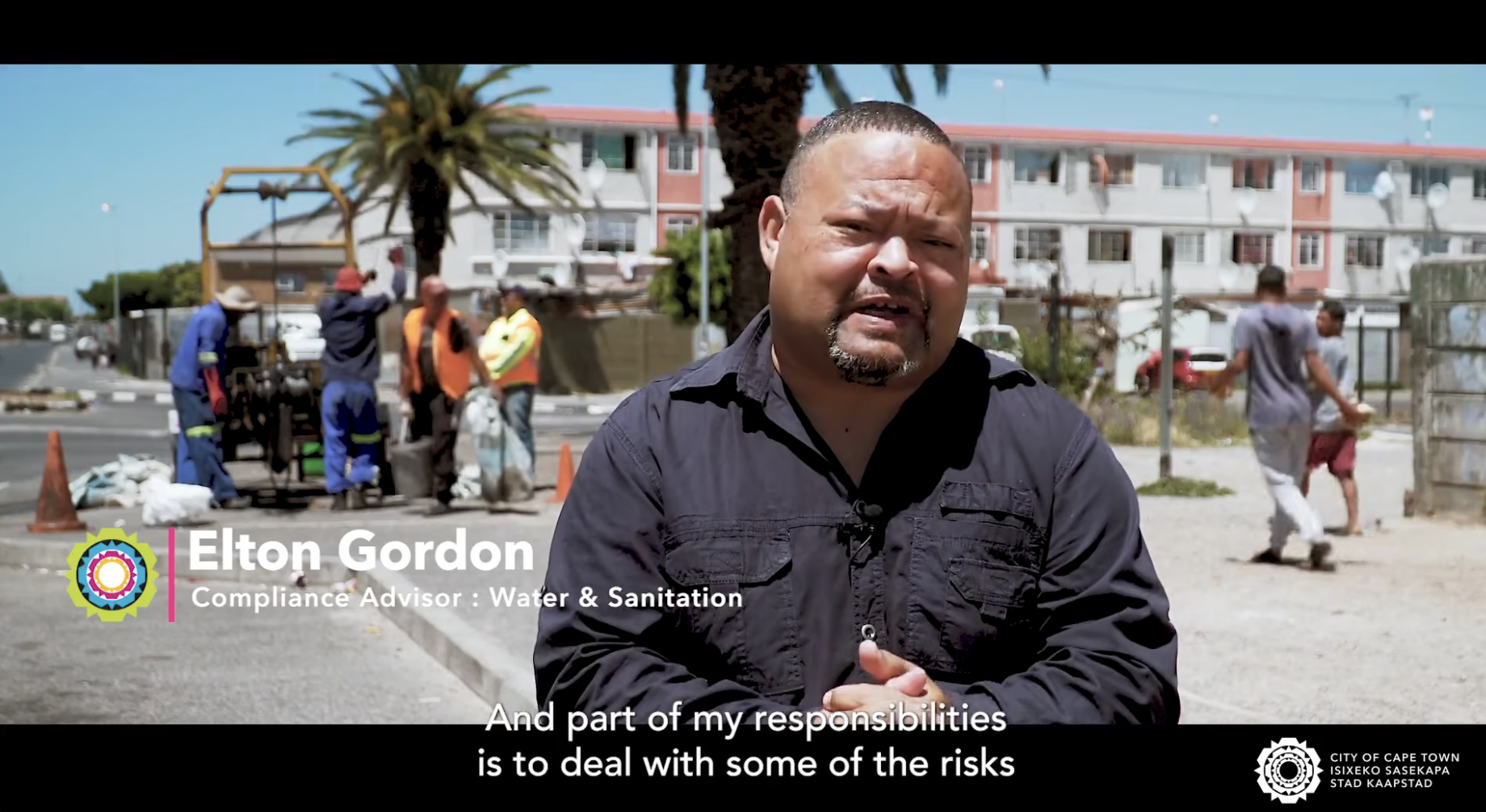
Elton Gordon, Compliance Advisor for Water & Sanitation, featured in the City of Cape Town’s frontline staff appreciation series
Showing up in the places where things are being quietly fixed is not soft politics. It is long-term infrastructure. It signals to civil servants that their work is seen and it’s worth doing.
It shows citizens that competence exists inside government and can be found and celebrated. It gives leaders something to point to that isn't drama. And it builds the kind of loyalty that doesn't evaporate when things get difficult.
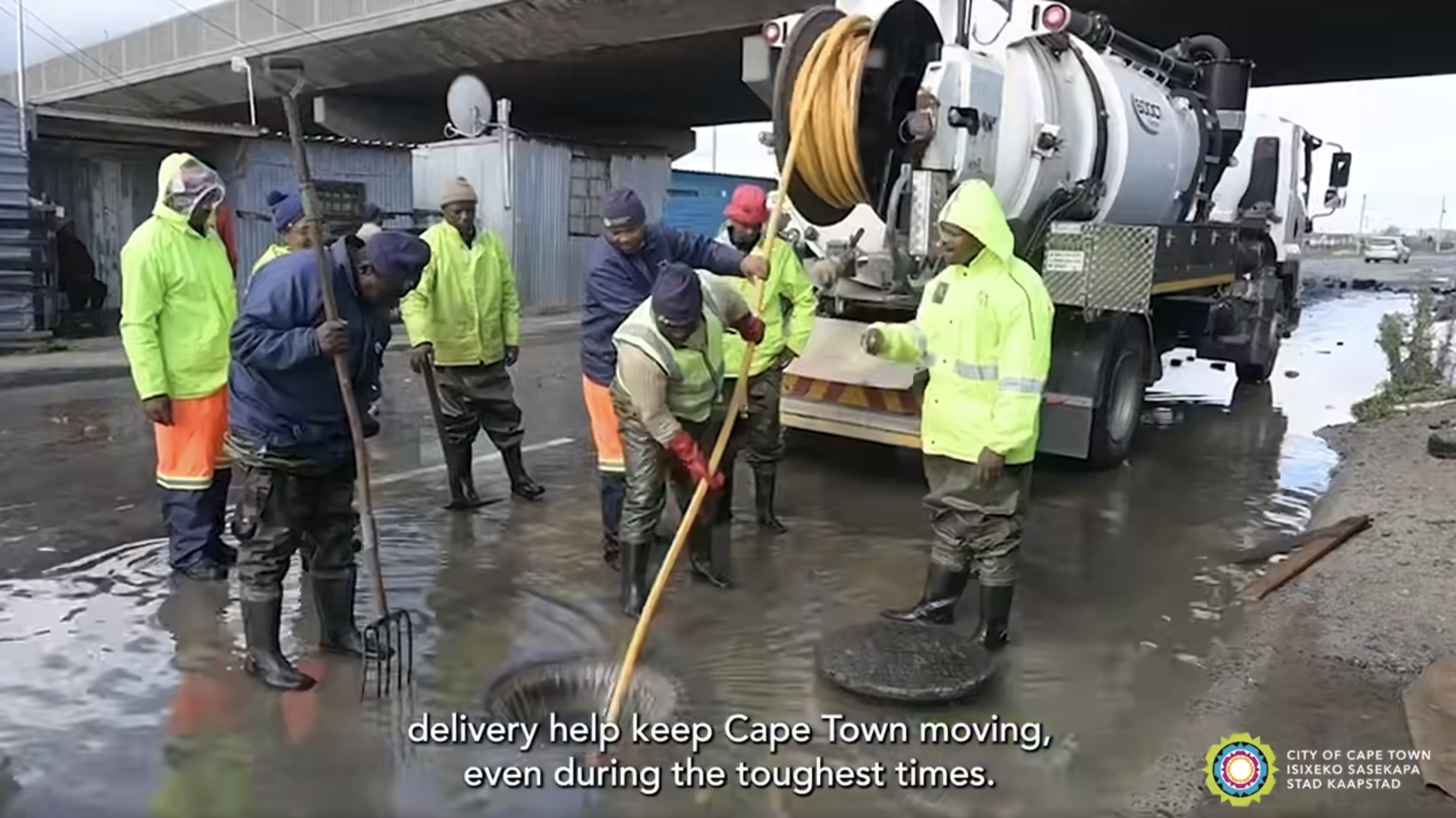
Pass the mic. Put the repairer on camera, not just the broken pipe. Name the official who turned it around. Make the civil servant the hero, too.
The swim that secured 1.55 million square kms in Antarctica
In early 2015, Lewis Pugh pulled on a Speedo and undertook five swims in the freezing waters around Antarctica, his Five Swims for One Reason challenge, to push for the Ross Sea to be declared a Marine Protected Area. He had been making the case in conference rooms for years. The body that oversees Antarctic waters had been deadlocked for five years. Russia had blocked the proposal at least five times.
So he took a camera crew, went to the Bay of Whales, further south than anyone had ever swum, and got into water at -1.7° Celsius, with air temperatures down to -37°C.
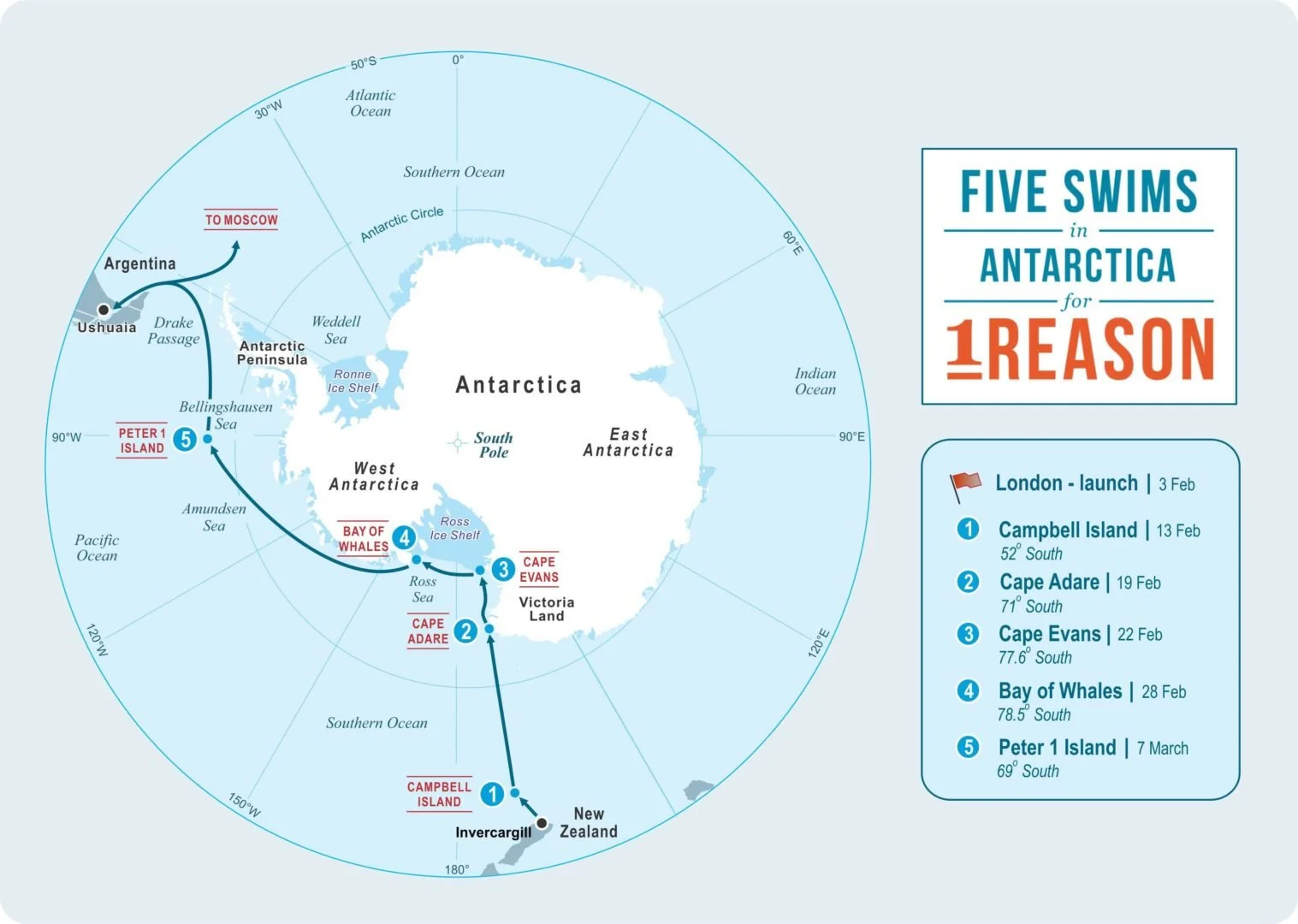
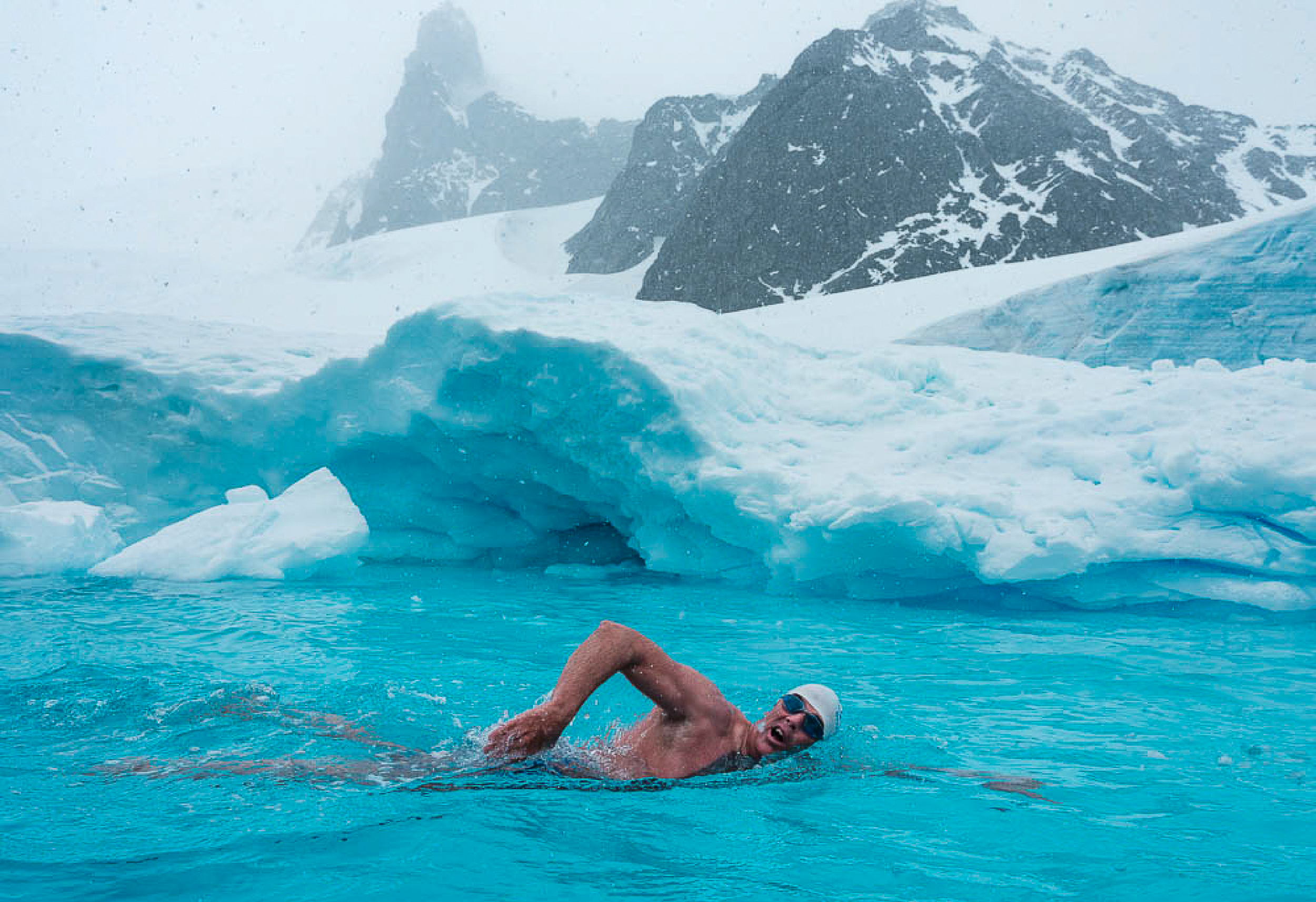
PHOTO CREDIT: Kelvin Trautman
The footage did what the policy papers couldn't. Pugh then carried that footage and his eyewitness testimony ("I have seen...", not "reports indicate...") straight into the Kremlin, making numerous trips to Moscow to ask Russia, face to face, to change its position.
Eventually, they did.
In October 2016, 24 nations and the EU agreed unanimously to protect roughly 1.55 million square kilometers of the Ross Sea, larger than the UK, France and Germany combined, the largest protected area on the planet, on land or sea.
One swimmer. One ocean. A door jammed shut for five years, now open.
The Anchoring Principles
When you need to turn the narrative, a sharper argument doesn’t help.
These times require:
Go and see for yourself: Get out of the press release. Get to the pothole, the harbour, the housing block, the clinic. Respectfully witness, ask. Your camera, and theirs.
You’re not the hero in the scene: Not the leader. Not the donor. Not the party. The welder, the fisher, the mother at the dry tap. And the clerk, the engineer, the crew who showed up at 2am. The story is theirs.
A memorable scene, not a statement: Develop your taste for tiny stories that can stick. "Corruption is rampant" loses to a Dior bag full of cash. "Service delivery is working" loses to a mum turning on a tap for the first time.
A visual that can't be argued with: Anyone can dispute a claim. It’s harder to dispute footage with coordinates and faces people recognise. Taken and shared by people of that place who were there too. And they might want a selfie*
Show up where things are being fixed, not only where they're broken: The repair is a story too. Name the competent people making it happen behind the scenes.
Volume, deployed honestly: One story is fragile. Thousands of compounding citizen-led stories told from their POV, builds signal, and becomes culture.
The Show Don’t Tell contrast that rebuilds trust
AI has made it cheap to develop and distribute arguments online. Weaponised words and marketing mechanics designed to clench tummies, jaws and fists.
But demonstrably being there for the journey from listening to the named individuals dealing with the issue, to reporting back, (especially where it hits snags) through to delivery, is too rare. As a consistent strategy, it earns legitimacy. Speaking to a familiar face, someone with the power to change things, no matter how challenging, helps people feel seen and safe.
It’s not a once-off. South Africans have been promised presence before. They know the hard hat tour. They know the visit that goes nowhere. What they have seen far less of is a leader who comes back. Who shows up not for the camera moment but for the conversation. Who stands with the woman whose tap hasn't worked since 2022, and is still there six months later when it gets fixed, naming the people who fixed it.
That kind of presence is not partisan. It isn’t spin. It is the most basic form of respect: showing up in someone's reality and taking it seriously. The fact that it also happens to be the most effective thing a communicator can do is the pleasant surprise.
Your opponents are still shouting about what you said in 2017. You are standing with the people, and coming back. The country can see the difference. That's not partisan, it's just decent.
So the question to ask in every campaign meeting, every comms huddle, every Monday morning: Where are we going this week, and who are we bringing the country with us to meet? Not what are we saying. Not what is our message. Where are we going. Who is the hero. What scene can we get on the public record that the other side cannot dispute, cannot match, and cannot un-see.
Show up. Celebrate those fixing things. The citizen is the hero, hear them and pass the mic.
The stories slowly compound, get shared, and build trust neighbourhood by neighbourhood.